Paper Planner vs App: Which Keeps You Organized?
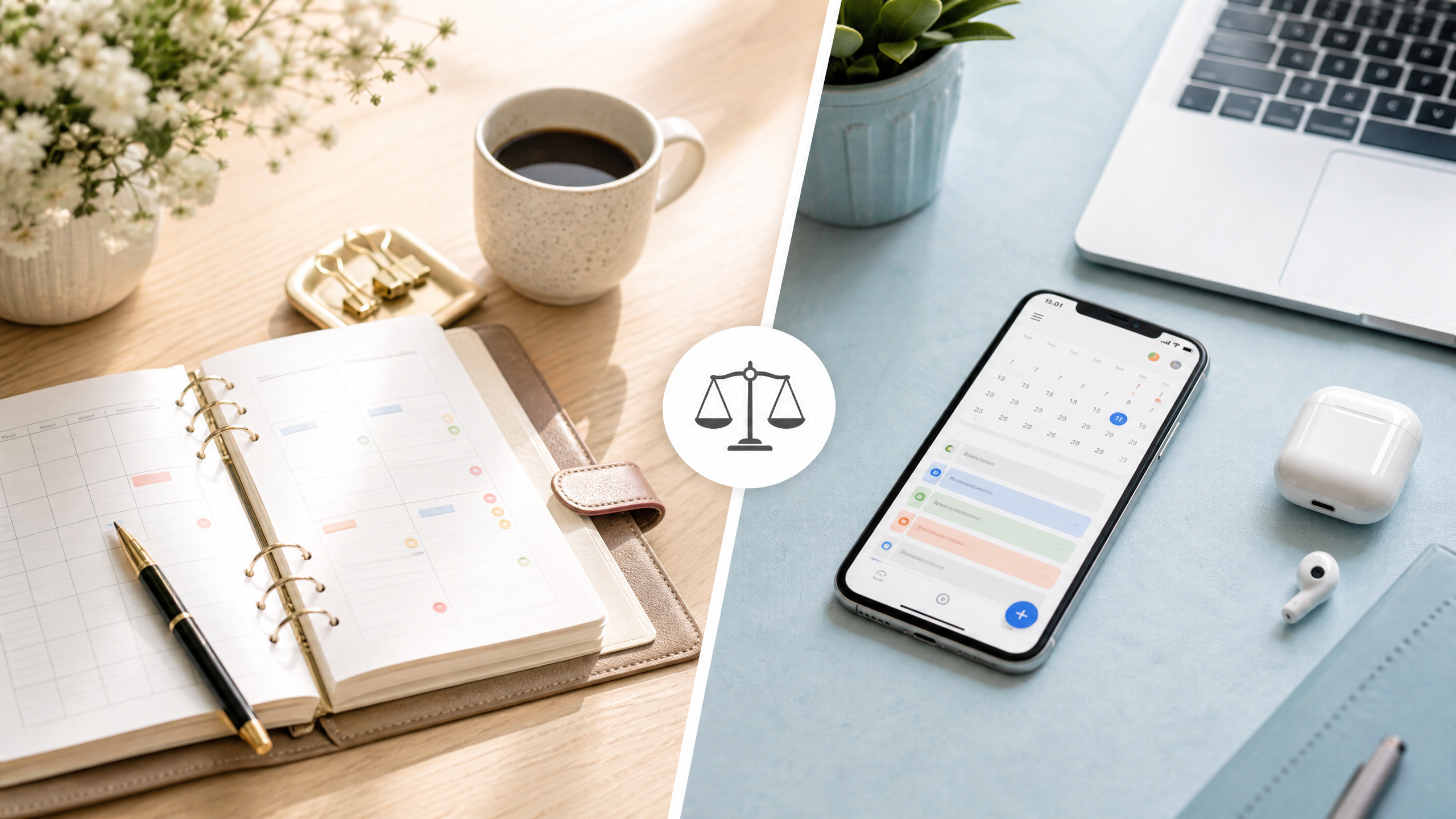
Introduction
When the calendar flips to a new year, the age‑old question resurfaces: should you reach for a leather‑bound paper planner or open a sleek digital app? The answer isn’t simply “paper wins” or “apps dominate.” It hinges on how each tool extends our mind, reduces cognitive friction, and fits the rhythm of our daily lives. In this article we evaluate the two approaches through the lens of external cognition—the idea that a well‑chosen planning system becomes an "outside‑the‑brain" memory aid. By weaving together recent academic studies, market surveys, and environmental analyses, we aim to give you a nuanced roadmap for choosing (or combining) the method that truly keeps you organized. Check it out here.
As an Amazon Associate, we earn from qualifying purchases.
External Cognition: A Unifying Lens
External cognition treats any artifact—paper, a phone screen, a voice‑assistant—as a partner in thinking. Rather than debating the medium in isolation, we ask: *How does the artifact off‑load mental work, support habit loops, and protect us from distraction?* This perspective shifts the conversation from a binary "paper vs. screen" to a more productive question: *Which medium best augments the specific cognitive tasks I need to manage?* The six sub‑points below map directly onto the external‑cognition framework, illustrating where each tool excels or falls short.
Cognitive Load and Memory Off‑loading
A 2022 study from the University of California, Irvine demonstrated a striking memory advantage for handwritten planning. Participants who wrote tasks in a paper planner recalled 30 % more items after one week than those who entered the same items into a mobile app. The researchers linked this to the generation effect—the brain retains information better when it is actively produced rather than passively typed. The tactile sensation of turning pages and the visual cue of a filled‑in line serve as physical anchors, reinforcing the encoding trace.
Digital apps, by contrast, rely on visual scanning. While they can present information in a compact, searchable list, the act of typing or tapping does not produce the same motor‑memory synergy. Moreover, app‑based planning often coexists with a flood of notifications, creating “attention residue” that raises perceived mental load. If your primary goal is to cement tasks in long‑term memory, a paper planner still holds a measurable edge.
Flexibility, Searchability, and Integration
When it comes to rapid editing, bulk rescheduling, and cross‑platform sync, digital planners are unrivaled. A 2023 Gartner survey of 2,500 knowledge workers found that 78 % cited the ability to search past entries and import calendar data from Outlook or Google Calendar as decisive for staying organized. Apps can also generate analytics—time‑budget heat maps, task‑completion rates, and predictive reminders based on past behavior—features that would require manual transcription in a paper system.
These capabilities matter most for people juggling multiple projects, freelancers coordinating with clients, or teams that need to link tasks to project‑management tools such as Asana or Notion. The integration of AI assistants further reduces duplication of effort, allowing you to capture an email, voice command, or meeting note directly into your digital planner without an intermediate step.
Distraction Risk and Device Fatigue
Convenience carries a hidden cost. A 2021 experiment published in the Journal of Experimental Psychology reported that participants using a smartphone‑based planner experienced 23 % more task‑switching events per hour than those using a standalone paper notebook, even when notifications were muted. The mere presence of a multipurpose device creates a “contextual cue” that primes the brain for checking messages, social media, or news feeds, eroding the deep focus needed for complex work.
Paper planners, by design, are single‑purpose. Their limited interactivity makes them effective “focus anchors,” reducing digital fatigue and the temptation to drift into unrelated apps. For anyone whose work demands sustained concentration, the low‑distraction environment of a physical notebook can be a decisive advantage.
Portability, Durability, and Environmental Impact
Weight‑wise, a typical weekly paper planner is about 200 g—light enough to slip into any bag. However, paper is vulnerable to water, tearing, and loss. Digital planners survive spills, sync across devices, and are always at hand as long as the battery lasts. A life‑cycle analysis by the Ellen MacArthur Foundation (2022) estimated that a weekly planner generates roughly 0.5 kg CO₂e per year, whereas the incremental carbon cost of using an already‑owned smartphone for planning is under 0.05 kg CO₂e. The environmental trade‑off is modest, but it becomes salient for eco‑conscious readers who track every gram of waste. Choosing a recycled‑paper planner or a low‑energy app can further tip the balance.
Habit Formation and Personal Accountability
Habits form through a loop of cue, routine, and reward. Paper planners provide a tactile cue—opening the book—and a visual reward—crossing off a line. A 2020 behavioral‑science report from the Behavioural Insights Team found that 61 % of users who physically crossed out tasks reported higher satisfaction than those who toggled a digital checkbox, attributing the boost to dopamine release associated with the motor action.
Digital apps, however, can gamify the experience. Streaks, badges, and push‑notifications act as external accountability mechanisms that resonate especially with younger users accustomed to instant feedback. For instance, the popular planner app Todoist lets users earn points for completing tasks on time, creating a sense of progression that can reinforce consistency.
Accessibility and Inclusivity
People with visual impairments, dysgraphia, or limited motor control often benefit from the assistive features built into modern apps: screen‑reader support, voice entry, adjustable font sizes, and high‑contrast themes. Paper planners lack these built‑in accommodations, though larger‑print or Braille versions exist but are niche.
Conversely, individuals with low digital literacy, limited internet access, or a preference for low‑tech environments may find paper planners more inclusive. The World Health Organization’s 2021 “Assistive Technology” guidelines recommend offering both options in workplaces to ensure equitable access.
Hybrid Strategies: Getting the Best of Both Worlds
The evidence suggests that a binary choice rarely maximizes productivity. A hybrid approach lets you assign each medium to the type of work it handles best. Consider the following workflow:
- High‑visibility, habit‑forming tasks (daily to‑dos, morning routines) go in a paper planner. The physical act of writing and checking off reinforces memory and satisfaction.
- Dynamic, data‑heavy items (project deadlines, meeting notes, recurring events) live in a digital app. Use its search, integration, and analytics to keep the information up to date.
- Weekly review: Transfer completed paper tasks into the app to capture metrics, then clear the paper pages for the next week. This ritual leverages the strengths of both external‑cognition systems.
By treating the two tools as complementary extensions of your brain rather than competitors, you can craft a personalized organization system that adapts to changing demands, reduces cognitive load, and minimizes distraction.
Conclusion
Paper planners excel at off‑loading memory, fostering tactile habit loops, and shielding you from digital interruptions. Digital apps dominate in flexibility, integration, and analytics while offering accessibility features that paper cannot match. The environmental impact of each is relatively small, but the choice can reflect personal values around sustainability.
Ultimately, the question isn’t *paper vs. app*—it’s *which external cognition partner best supports the tasks you need to accomplish today and the goals you aim to achieve tomorrow?* Embrace the hybrid model, let each medium play to its strengths, and you’ll find a more resilient, organized workflow that works for your brain, your lifestyle, and the planet.